

There is a principle at the heart of Baha’u’llah’s teachings that most Baha’is know almost by heart: independent investigation of truth.
We are told not to blindly follow our parents, or our clergy, or traditions or the opinions of others. We are expected to read, investigate, think and arrive at truth through our own sincere search. But there is an interesting question that deserves to be asked:
Does independent investigation stop when we reach the doors of the Baha’i Administration?
Consider money.
Baha’is are encouraged to contribute to various funds. There is the local fund, the national fund, international funds, Huquq’ullah and other appeals connected with the work of the Faith. Giving is presented as a spiritual act, and there is certainly nothing wrong with generosity.
But generosity and accountability are not opposites. If someone asks you to entrust them with your money, it is unreasonable to ask what happens to it?
Of course not.
A family keeps accounts. A business keeps accounts. A charity keeps financial records. An organization entrusted with other people’s money normally has systems of reporting and oversight.
So why should a religious institution be different?
“The House of Justice does not issue an accounting”
Here the matter becomes particularly interesting because we do not have to speculate about the position of the Universal House of Justice. Its published material addresses this very question.
In a 2006 letter written on its behalf concerning Huquq’ullah, the Universal House of Justice stated plainly:
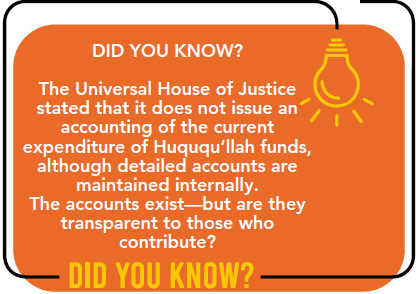
“The House of Justice does not issue an accounting of the current expenditure of these funds.”
The same letter explains that detailed accounts of Huquq’ullah income and expenditures are maintained internally and that the House of Justice considers its own assurance sufficient for members of the Baha’i community.
It further states that there is no need, at present, to present those accounts to external audiences.
Read that again.
The accounts exist.
They are maintained.
They are examined internally.
But the believers who contribute the money are not given the accounts.
Instead, they are given an assurance.
And this raises a question that should not be considered rebellious or disrespectful:
Why should assurance replace transparency?
Trust is not the same as accountability.
Nobody is suggesting that every person serving in the Baha’i Administration is dishonest.
That is not the point.
The question is much simpler.
Suppose you gave your money to a charity and asked to see its accounts. Would you be satisfied if the organization replied:
“We keep detailed accounts. We have examined them ourselves. Everything is being handled with integrity. You have our assurance.”
Perhaps some people would.
But most would reasonably ask for more.
And there is a good reason for this.
Accountability does not exist because everyone is assumed to be dishonest. Accountability exists because everyone is human.
Good financial systems protect honest people just as much as they expose dishonest ones.
When people know that expenditures will be recorded, reviewed and explained, they naturally become more careful with money. Transparency creates discipline.
Without meaningful external accountability, the person spending the money is effectively answering to the same system that controls the books.
That deserves examination.
What about Huquq’ullah?
The issue becomes even more significant with Huququ’llah.
Baha’u’llah describes the Right of God as a sacred obligation, and the Baha’i texts explain that its disbursement is entrusted to the Head of the Faith.
The Universal House of Justice states that the funds may be used for a broad range of purposes, including the work of the Faith, Holy Places, institutions, Houses of Worship and charitable and benevolent undertakings.
These may all be worthy purposes.
But a worthy purpose does not eliminate the need for accountability.
In fact, it should make accountability even more important.
If believers are giving their hard-earned money because they sincerely believe it is being used to serve humanity and advance the Cause of Baha’u’llah, they deserve confidence that the system handling those funds is operating with the highest possible standards of transparency.
Instead, they are effectively asked to say:
“We trust you.”
But where did Baha’u’llah teach us to surrender our capacity to question?
The contradiction
This is where the issue becomes bigger than money.
The Baha’i Faith teaches the individual to investigate truth independently.
Yet when the subject becomes the Administration, believers are often encouraged to accept its decisions because the institution is trusted.
We are encouraged to question inherited religious beliefs.
But questioning administrative decisions can be treated very differently.
We are encouraged to examine the Writings for ourselves.
But when an institutional interpretation is presented, questioning it may be regarded as disobedience.
And when money is involved, the standard can become even more uncomfortable:
Give freely — but do not expect to see the books.
Is this really what independent investigation was supposed to mean?
Who serves whom?
This is the question Free Baha’is believe needs to be asked.
The Administration exists to serve the Cause. It does not own the Cause.
The institutions exist to serve the believers and advance the teachings.
The believers do not exist merely to sustain the institutions.
That distinction is fundamental.
Baha’u’llah’s Revelation was not established to create another religious bureaucracy demanding unquestioning loyalty. It was meant to awaken the individual, liberate the conscience and bring humanity into a new relationship with truth. When an institution becomes so powerful that believers begin to feel that questioning it is equivalent to questioning the Faith itself, something has gone seriously wrong.
And when an institution receives money but tells the people providing that money that its own assurance is sufficient, we should at least have the courage to ask whether this reflects the spirit of Baha’u’llah’s teachings.
The question is not “Where did the money go?”
We should be careful here.
Without access to the accounts, nobody outside the system can responsibly claim that the money has been misused.
That is precisely why transparency matters. The question is not:
“Can we prove that something improper happened?” The question is:
“Why should believers have to prove wrongdoing before asking for accountability?”
That reverses the entire principle.
A transparent institution does not wait for suspicion before explaining itself.
It explains itself precisely so that suspicion has less room to grow.
The Faith deserves better
Free Baha’is are not opposed to giving.
We are not opposed to supporting genuine teaching work, education, charitable projects, Houses of Worship, Holy Places or the many sincere believers who dedicate their lives to serving humanity.
We are questioning something more fundamental:
Why should faith require financial trust without corresponding financial transparency?
If the accounts are carefully maintained, let meaningful accountability demonstrate it.
If the funds are being used exactly as represented, transparency can only strengthen confidence.
If the Administration truly believes in independent investigation, it should welcome sincere questions rather than regard them as threats.
Because ultimately, this is not really about money. It is about conscience.
It is about whether a Baha’i is allowed to remain an adult human being capable of asking difficult questions.
It is about whether “trust” has become a substitute for evidence.
And it is about whether the institution has quietly become more important than the principles it was created to serve.
Baha’u’llah taught humanity to investigate truth.
So let us investigate everything.
The Scriptures.
The history.
The institutions.
The interpretations.
And yes — even the accounts.
If an institution is genuinely serving the Cause of Baha’u’llah, honest questions should not threaten it. They should strengthen it.
“Trust us” is not accountability.
And in a Faith built upon independent investigation, no institution should ever be afraid of being examined.
Leave a Reply